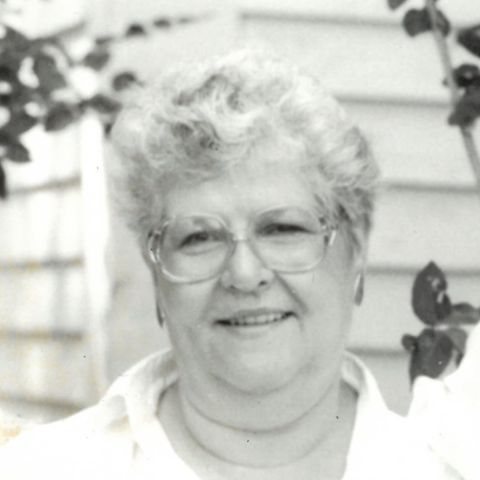
Marion Kuklewicz, (1932-2017) of Turners Falls, MA
interview by David Nixon 3-16-1994; Tape 10.1 of 16
Edited by Pam Hodgkins 6-12-2025; Jeanne Sojka 8/4/2025
David: Okay, there we go. Today is March 16th, 1994. My name is David Nixon.
I’m speaking with Marian Kuklewicz at 22 Worcester Avenue in Turners Falls, Massachusetts. This is the second part of our interview. And so, good morning to you.
Marion: Good morning, David. And it’s good to see you today. Yesterday was, yesterday being March 15th, was an important day in my family.
If my dad had been alive, it would have been his 102nd birthday. Yeah.
David: Yeah.
Marion: Yeah, 102nd birthday. So, I think that was kind of noteworthy. And it would be, let’s see, February 2nd in 1917 [1914] was the year that my parents were married.
So, you see, he was quite a young man. And my mother, whom we didn’t get a chance to talk very much about last time we were here, was just a young girl of 17 years old at that time.
David: So, she was married when she was 17.
Marion: She was married when she was 17. Very, very young. And quite a tiny little, pretty little lady, actually.
She was not born in Ukraine. She was born of Ukrainian immigrant parents who had come to America back in, actually in the 1800s. And I don’t know the exact year.
Her father came over and when he got off the ship at Ellis Island, was taken to Pennsylvania to work in a coal mine. But he didn’t like working in the coal mines very much. So, he and some friends had decided to start a bar room, a tap room, or a tavern. I guess
they probably called it back in those days. And he did that for a while. But then made his way to Sunderland where, I believe, is where he met my grandmother.
And they lived right on the line between Sunderland and Hadley. On Route 47. And that’s where my mother was born and lived there for a while.
And then they purchased another piece of property, which was on the Amherst Road, Route 116, in just about, oh, about two and a half miles south of the center of Sunderland. And that’s where my mom grew up and met my father when he was working, as I told you last week, in the fields down in the north, along the Connecticut River, down along Main Street in Sunderland. And they were married.
And very shortly within the next year, my oldest brother was born. And that started their whole family community. My mother was very young and had had a lot of responsibilities from the time she would be a girl.
She only went to school in Sunderland, the grammar school, until the third grade. And then she was ill and was at home due to a very serious illness for about a year. At which time her mother’s family was growing, you know, brothers and sisters, and her mother became quite ill.
So she stayed at home. And from the time she was in the third grade, so that would probably make her about nine years old maybe, she was responsible for helping to take care of her brothers and sisters and help her mother with household chores. So even though she was very young, she was well-versed in housekeeping and child care and so forth.
Not only did she become a mother, but she also was, quote-unquote, the right-hand man to my father because she had to help him with the farming. She not only took care of the children, but she had to go out and work in the barns to take care of the dairy animals and perhaps the pigs and chickens and things like that. And that was her responsibility while he did the heavier work.
And then there were other children that came along. During the course of their marriage there were ten children. There were five boys and five girls.
Of course, sons were much wanted. If you were a farmer, sons were much wanted. And so the first four children were boys.
David: Why was that?
Marion: Well, because they grew up and helped on the farm. That way you didn’t have to hire help when it was time to harvest crops and things like that. Also, they could help take over part of the chores that were necessary to family life at night.
Not that daughters weren’t welcome, but it was quite nice to have those sons first. So there were four sons, and my mother used to always tell us she was in despair. She thought she’d never have a little girl, and she very much wanted to have a daughter.
But her fifth child was a girl, and then she had two more girls. Then she had another boy to make up the five, and then there were two more. And I’m the ninth of the ten children that she had.
Not only did she work outdoors and take care of us children, but she did a lot of things that today we don’t even think we have time for. And I marvel at how she was able to get everything done. Her days started very, very early in the morning.
She would be up at 3:30 or 4 in the morning.
David: Wow.
Marion: Yeah. Really, farm women always got up very early. But before she would go out to do chores, she would start making bread, and she would get the bread all mixed and kneaded and set to rise. Then she would go out and do chores.
And when the oldest children were very small, it meant that she’d have to bundle them up and take them out with her because she couldn’t leave them in the house when it ended. So she’d have to bundle up the boys and take them out to the barns, and hope that they wouldn’t get into too much mischief. While she was helping my dad with the chores and all.
And then, like in a lot of big families, as the number of children increased and the older ones got older, then each one was responsible for taking care of the younger ones until they were old enough to go out and work. Once the boys got older and could go outside, she didn’t have to go out quite so early in the morning. The other thing that I always remember my mother did, my mother was a very, very, very soft, very gentle person.
Very soft-spoken, very shy, rather a retiring person. She always had many, many good things to do in her house. One of the things that you never came into her house when there wasn’t a pot of soup on the stove.
Marion: And I probably told you before, when I was a little girl, about the stone soup.
David: No.
Marion: I didn’t tell you about the stone soup? Well, when you have ten children, you always have to think of little games and ways to keep them busy.
To help you about them even knowing it sometimes. One of the things she used to do was, she would go to start soup, and we’d kind of be underfoot getting in the way, and she didn’t want to tell us to get out. So she would find little ways to keep us busy.
One thing she’d say, we’d say,” Mom, what are you making for soup today?” And she’d say, “I’m going to make stone soup. So you have to go out in the yard and find me a pretty stone, a nice, good-looking stone that I can bring in the house, and we’ll put it in the soup pot. “Of course, we’d always say, “that’s dirty,” or something like that.
And she’d say, “well, you have to bring it in the house.” Then she’d set us to work at the kitchen sink washroom, getting it all cleaned and polished. And she’d tell us she was going to put it in the pot, but she really didn’t.
But we were too stupid to know that, so we thought she did. And then she’d say, “well, this is pretty good, but I need maybe some carrots, some peas, some string beans.” And she’d send us each out to a certain part of the garden to go back and bring the things in.
Or if it was in the wintertime, she’d send us down to the root cellar to get the potatoes and the carrots or whatever was down there, beets, to put in the soup. So actually, she was making vegetable soup, but she told us it was stone soup, and we thought that was really something. So we wanted to do all those little chores for her, and that freed her up to stay in the kitchen to be doing things that were more important.
And then she didn’t have to make all those many trips. You know, she probably would have done it in one trip, but she’d send us off on all these errands, keeping us busy, keeping us out of her hair so it was big so she could get the work done. But there was always, always a pot of soup on the stove.
Of course, we lived in an old farmhouse, and it was heated, basically heated by wood, so she had a wood-burning cookstove, if you can imagine baking and cooking and doing it all in a woodstove. But not only would she make homemade bread, but if we were to have cookies and pastries, she used to make all of her own pastries and everything else that we ate, she had to start from scratch. She didn’t go to the store and buy anything like in a box.
And I can think of so many pleasant things we had. Food was very important to our household because we all worked so hard that we needed to have three fairly substantial meals to keep us going. And we were not considered wealthy.
We were rather, you know, we were struggling with so many people in the early 1900s. My earliest recollections, of course, are in the 30s, which was during the Depression. And I can remember her cooking things for us for breakfast, like cornmeal mush was one of those things that she used to cook for us for breakfast.
It was substantial, it was relatively inexpensive, it was good with whole milk, it really was a good breakfast to start our day off. But I didn’t particularly like cornmeal mush, that was not my favorite. But she would cook a great big pot of it, and after breakfast there would be leftovers.
And she used to pour it into like a loaf pan that she’d bake bread in, put it in the refrigerator and let it get hard. And the next day was when I really liked it. So she’d take it out of the pan, and she’d slice it, and she’d brown it, and she’d butter it in the skillet, and we’d have it with maple syrup. And that was my treat, that was my treat.
David: That’s what the southerners call slush.
Marion: I know, I didn’t know that until about a year or so ago. I was with a group of people in Amherst, and they were talking about their southern roots. These happened to be some black ladies, and they were calling it grits. And when I said how my mother used to make it, they were amazed that somebody of our culture would know to make grits, and they’d get the biggest kick out of it.
But they didn’t know to eat it with maple syrup, cuz down south, they probably didn’t have the abundance of syrup that we had here in our area. And so that was one of the favorite things.
And then other standbys that she used to feed us, because we were so many, and again, money was fairly scarce, she used to make, for dessert, she used to make great big bowls of bread pudding. And at that time, I had an uncle who was not able to find work, and so, not like the food stamps that people have today, they used to receive some surplus food. And one of the things they used to get are large quantities of raisins.
Well, he was married to a girl who didn’t know how to cook, and if she did know how to cook, she wouldn’t take the time to do it anyway. So he would get the raisins, he would bring them to my mother and say, “what can you do with these?” And she’d say, “well, I can put them in grits or other thing.” So she used to use quite a generous amount of raisins in the bread pudding. And then we had our own farm, so we had lots of eggs and lots of nice cold milk.
So that was a good way to use up dry, crusted bread. And like so many people did back then, and I know it’s available today, but we used to have the little neighborhood bakeries that baked bread. Now, we didn’t buy that bread to eat particularly for our main bread source, but my father would go to the bakery and buy the day-old bread, and it would be a little bit on the hard side because, of course, it wasn’t made the same as homemade bread.
And my mother would use that, cut that up and put it into bread pudding, or if you had French toast, that’s what you’d use that for. And we would have bread pudding as one of our desserts. That was a traditional dessert in our house.
The other thing that was very inexpensive and relatively easy to come by was rice. And so she used to make a lot of rice pudding for us. And again, we had the fresh eggs, we had the fresh milk, she had these raisins that were given to her, so we could have a nice bowl of rice pudding. And we always had cream fresh from the farm to go on top of it, whether it was just cream poured on or whipped cream, either way, it was nice.
So that probably explains why I look like I do today. You know, all those little fat cells just soaked up all those little things. Another favorite that she used to make in the wintertime was we had the farm and we had a big garden, and she used to can, we didn’t have freezers then, so she used to can everything.
And one of the things that she used to can was tomatoes. And we would can probably about 200 quarts of tomatoes to use during the wintertime for soups and stews and so forth. But she had a breakfast food that she used to make with tomatoes that was like cream of tomato soup, but not like we buy in cans, but it was real chunky, real chunks of whole tomato, and then she would thicken it with usually the top, the milk that she would skim off the top, so it was really like the heavy cream.
And she would spice it, and I have tried and tried and tried, and I can’t make it taste like hers. It was sort of sweet and spicy, and again, we’d have it over “czerstwy chleb” – the day-old bread. And that was a good, hot meal to have in the morning.
You had your bread, you had your milk, you had your tomatoes, so it was really good. And after you’ve been out in the barn and done a couple of hours’ worth of chores, you are hungry and want a substantial breakfast. So that was one of the favorites in the wintertime.
And the spices just really, really warmed you right up, from your toes right up to your fingertips. It was really great. And I can’t, she never had written down the recipe, so I don’t have it, but it was one of the things that I loved.
I couldn’t wait to eat hot tomato soup in the morning, which sounds like a strange thing to talk about, but it really was. It was really a hot, bubbly delight. I guess no different than having a glass of tomato juice.
But it was always perfectly acceptable to eat that for breakfast. Then there was another thing that my father used to like. It wasn’t the best thing for him to eat, because he wasn’t very well, but she used to make a noodle or a dumpling type of breakfast food.
And again, you have to remember, we didn’t have English muffins and bagels or all these nice things that you go to the store and buy. So she’d have to improvise and do all her own cooking. She used to make a potato noodle, which she called “kluski.”
And it was done…
David: How do you spell that?
Marion: I don’t know how to spell it. I can look it up in a minute for you. Okay.
But I don’t have it. And I’m not sure if that’s a Polish word or Ukrainian word, but she called it kluski. I think it’s K-L-U-S-K-Y, but I’m not sure.
And she would make those. They were made with warm mashed potatoes and egg and flour and a little salt and pepper. And she would mix it all together to make a sticky dough.
And then she would take a spoon and sort of like you dump dumplings into stew, she would dump them into boiling water and cook them. And then she would serve them with the top milk, the cream. . . a little salt and pepper, and it can be another substantial breakfast food.
Can you imagine how heavy that stuff was? It was like rocks. But they were so good. I mean, I think about it now, and I can’t believe we ate all these heavy things.
That’s probably why I never grew to be six feet tall. I probably stunted my growth for all this heavy food. But she was a marvelous cook.
She was a really marvelous cook. Most of her, most of the things she cooked were not necessarily from a cookbook. They were probably things that she learned from her mother, things that she learned from other people that she talked with.
We might have, Sundays were usually sort of a leisure day, especially for the women. My father didn’t take many days off at all. He generally worked every day, seven days a week.
But I think I told you last time, he was pretty much a workaholic. But my mother would take Sundays as her leisure day. So after church, it was the custom for the women to sort of chat for a while after the service.
And they might talk about different foods that they cooked, ways to stretch the foods that they had, and share recipes, as women still do today. And then as she got older, I’m sure she was always trying to cook. But basically she cooked by instinct.
And like when she made bread, I’d say to her, “Mom, how do you do it?” And she’d say, “Oh, I put some eggs and some milk in the bowl, and then I put my yeast in, and then I add enough flour. And when it feels good, I know it’s ready. “ You know, so I couldn’t rely on someone else’s recipes.
I don’t have the touch of getting a pinch of salt or a handful of flour like she did. So I had to rely on recipes. But basically she was rather an experimental cook, I would guess you’d have to say. But they just seemed to have so much instinct for being able to put things together and make it something really, really great. And as children, as we grew older, then we began to start looking for recipes.
Very often our source of recipes would come from word of mouth. They were passed down word of mouth from the older generations, you know, even generations before my mother. Things we would pass down, and we’d look at the recipes and see if it came out good.
And we’d try to write down the recipe. And I can remember my mother having one of those composition books with the plastic white cover and the stitched-in pages. She would have little notes scribbled in there of things that she had done.
They came out good, so she’d record that as a recipe. And unfortunately, I don’t have those books now. They were lost.
She had given them to one of my sisters who had really a flair for cooking. And a few years back, my sister’s house had a fire. They lost everything in the kitchen.
So a lot of those handwritten recipes that we had that would have been really nice things to pass down in the generation were destroyed in the kitchen fire. Most of the house was destroyed, and the kitchen particularly. What happened was the fire started in the barn, and it was in wintertime, and the wind was blowing.
So it blew the flames into the house, and that whole ell was totally, totally destroyed. So a lot of the… That was after my mother had broken up her house. So a lot of her dishes and things that were family heirlooms, not necessarily priceless, but family heirlooms nonetheless, were destroyed.
So we lost a lot of things then.
David; What was your mother’s name?
Marion: Oh, I didn’t tell you that, did I? My mother’s name was Julia.
David: Julia?
Marion: Lillian. And in parentheses, she might write “Lena” because some places it was Julia Lillian, and some places it was Julia Lena. My mother preferred Julia Lillian.
And her maiden name was Bishko, and they spelled it B-I-S-C-O-E.
David: B-I-S-C-O-E.
Marion: Which is the way it was interpreted when my grandfather landed at Ellis Island.
In Ukrainian, it comes out to the equivalent of B-I-S-H-K-O. And some members of the family who were better able to communicate the spelling retained the name B-I-S-H-K-O. We have other family members who live in Pennsylvania, still in the coal mine region of Shenandoah, Pennsylvania, who spell it B-I-S-C-O.
So it’s just a matter of when we arrived, what the interpretation was of the spelling when we landed at Ellis Island.
David: Now, Shenandoah, Pennsylvania, is that where your grandfather lived?
Marion: That’s where my grandfather lived when he arrived. He worked in the coal mines in Shenandoah, and I have many, many relatives in Shenandoah who still live in the town.
Most of them are older now, so they’re not active as miners anymore, but they’ve spent their whole life. This has nothing to do with my family, but just kind of FYI. Tommy and Jimmy Dorsey’s parents were Irish immigrants who worked in the coal mines in Pennsylvania, too.
And when they were young boys, they and some of my, I call them uncles, but they were actually cousins. Some of my uncles and the Dorsey brothers got together and formed a band in Pennsylvania and used to play music at different events there. And Tommy and Jimmy decided that they certainly weren’t going to spend their lifetime underground working in the coal mines, so as soon as they were old enough, they left.
But that’s the origin of that, but their origin, too. And it was interesting to note that the people on my mother’s side of the family, my grandfather and many of his uncles, brothers, cousins, were very musically inclined. And the people who lived in the coal mine, I think because they were underground so much that when they were above ground, they were very sociable and they had a lot of partying.
There were a lot of events where music was played. There was a lot more drinking in that side of the family, and it seemed to be their way of release from this horrible existence that they had to do in the coal mines. And, of course, it was very dangerous.
There were a lot of accidents and so forth. And I guess that was their way of coping, was to have more music, laughter, dancing, and partying than what was on my father’s side of the family. Not to say that that was a bad thing.
It just seemed that was their way of relieving stress. And music was very, very important for all of the time during the year, not just on special occasions, but all year long. It was very important.
Things like dance, music, that was all. We celebrated a lot in that branch of the family.
David: What was your grandfather’s name?
Marion: My grandfather’s name was Alexander Bishko.
I don’t remember him having a middle name.
David: He spelled it B-I-S-C-O-E?
Marion: In the United States, he spelled it B-I-S-C-O-E.
And my grandmother’s name was Anna, A-N-N-A. In the parentheses of her maiden name was G-O-U-D-E-N.
David: G-O-U-D-E-N.
Marion: And her last name was Korpita, K-O-R-P-I-T-A.
David: K-O-R-P-I-T-A. Was she Ukrainian, too?
Marion: I’m not sure if she… The Korpita side of the family is Ukrainian.
The Gouden I think might have been Czech or Austrian. I’m not sure. I never knew my grandmother.
I don’t know as much about her. She passed away before I was born.
David: Right. Now, she’s got her… She was married before she met Alexander?
Marion: No, her mother had been married twice.
David: Oh, I see.
Marion: And so she had the Gouden and Korpita names that she used.
David: Okay. Did Anna Korpita come from the Ukraine? Or was she born here in the United States?
Marion: No, she was born there and came over to this country. And I would have to assume from what I know, and again, I don’t know the total history, and this is something as we get to talk to some of the other people that I want to have you interview, we may find more background out on that by delving.
It’s not something that I’ve really researched that much. Yeah. But I assume she came to the United States as a young child, and then her parents settled in the Sunderland area.
And when we go out to do interviews in that area, I can show you, you know, some of the… I can show you the area where they lived. But she came over here, and they lived in the south part of Sunderland. It used to be called Hungarian Avenue where they lived, and that was because there were a lot of people who were Hungarian.
There were a lot of Lithuanian people who settled in that particular part of Sunderland, plus the Ukrainian, some Czechs. It’s now renamed, and it’s called North Silver Lane, or South Silver Lane, excuse me, South Silver Lane. But that’s what it was known, and it was sort of like a little section of the town, sort of like a little village, and they all sort of congregated there.
And I’m sure that when they came, because they didn’t have a lot of family and so forth, they probably lived in what we would consider communal housing now, simply in order to survive and have a place to stay. So that was sort of like a little section of the town that had gotten sort of nicknamed Hungarian Avenue. And then when the streets totally, you know, got really named, and the town was then called South Silver Lane.
David: Why did Alexander move from Pennsylvania to Sunderland?
Marion: Well, he didn’t. He decided that coal mining definitely was for him, wasn’t for him. As I said, they had the tavern, which he had worked in with a couple of partners, and I’m not sure exactly why he left there, but his background, again, was farming. And so he decided that he wanted to go back into farming.
He came to Massachusetts and started farming in Sunderland, and that’s where I would chance that he met with my grandmother.
David: But you don’t know why he chose Sunderland?
Marion: I don’t know why he chose Sunderland. I think that, as far as I can remember, the men in the Biscoe side of the family were people who liked to, they liked to travel for one thing.
They liked the outdoors. They liked hunting. They liked fishing.
So I’m wondering if maybe they were led to New England because of those aspects. I’m not sure. And this is something, as I say, this is something I haven’t been able to really find out.
I’ve asked with my remaining older brother and sister, and they don’t seem to know. So I’m hoping that when we talk to some of the other people, maybe we can find out more as to why this took place. And as I had referred to before, he did have a small farm, but he was what my father always called a gentleman farmer.
He wasn’t as serious about building a big farm or becoming a land baron, which my father really wanted to do. So he was content to have just a small piece of land and a few cows to sustain the family, you know, for milk, and chickens and pigs, eggs and meat and so forth. And he just grew some small crops.
I think he grew a little tobacco, which they sold, the leaf tobacco, broadleaf tobacco, which they sold, and some other crops and so forth. But he was not ever, you know, they had to have some hay and some corn and some other food. But they more or less just lived pretty much by the same standards that they did in the Ukraine, where they were peasant farmers and lived off the land to just sustain themselves.
And probably any real money that he made, he paid out for something else. And by the time I was a young girl, my grandfather was basically semi-retired. And by then, his sons were working and contributing so much.
As I said, my grandmother had died, and my grandmother died, oh, it would be 63 years ago now, so that was before I was born. And he had, you know, maintained the house, and he did have my mother there for, well, my mother wasn’t there. He did have a younger daughter who was there to help out, and then she left.
And so my three bachelor uncles and my grandfather all lived together as a single man. I had one uncle that got married and left, but the other three were bachelors. All their lives they had to marry back down here.
And my grandfather lived to be, oh, let’s see, he lived to be about 88 years old. You know, he used to basically do the cooking, some of the cooking, house cleaning. Sometimes when we got older, we’d go and help do the sprinkling, curtains, and things like that.
But basically they lived all their lives as single bachelors. I did have one uncle who was a cook. He cooked at the University.
David: Oh, yeah?
Marion: And so he kind of took care of all of those kinds of heavy cooking and baking and so forth. So they were all taken care of.
David: Well, let’s see if I’ve got this right. Alexander and Anna got married, and they had four sons?
Marion: They had, well, first of all, I have to backtrack a little bit. My mother was the oldest of the children, and when my mother was about 18 months old. Did I show you the picture of my grandmother and grandfather and my mother?
David: No, I don’t believe you did.
Marion: Can you stop the tape for a minute? I want to show that to you.
David: Okay, so tell me again.
Marion: Okay, when my mother was born, she was about 18 months to 2 years old, my grandfather and grandmother decided that they wanted to return to Ukraine.
David: Now, let’s see if I can get this right. Do you know when your mother was born? What year was that?
Marion: I think she was born in 1896.
David: Let’s see if we can compare that.
Marion: She was 17 years old when she got married.
David: Right. Do you know when they got married?
Marion: 1917. [1914]
David: Okay, so… Is that right? No, you’re off by about 65 to 40 years.
Marion: She got married in… Oh, wait a minute. Let’s stop this, and then I’ll go and look.
Marion: She got married February 2nd, and my oldest brother was born November 25th in 1914.
David: Okay, so your oldest brother was born… 19… 14, yes.
Marion: They were married in February, and he was born in November.
David: Uh-huh, and what was his name?
Marion: His name was Thomas Joseph.
David: And the next child?
Marion: The next child was John Michael, and he was born in 1916. They were four boys, so… They were four boys, and the next one was Andrew Frank.
David: Well, we have to correct that on the tape, otherwise we’d have my mother having children before she was married when she did. She had been awfully young. Yeah.
David:: Okay, and he was… Andy was born in 1918, and those three brothers have since passed away.
Marion: Uh-huh. And I have another brother who lives in Shutesbury now. His name is Harry Paul, and he was born in 1920.
David: The first little girl came along?
Marion: Then the first little girl came along, and her name was Rose Dora.
David: D-O-R-A?
Marion: D-O-R-A, and she was born in 1922.
David: And there was another girl?
Marion: And there was another girl, and her name was Helen Mary, and she was born in 1924, and both of these siblings have passed away. And if you notice, in these ages that I’m giving you, each of these children is about two years of age.
David: Right.
Marion: Back in the days when my mother was a young girl and had a good family, they hadn’t heard of anything such as birth control, but they nursed their children, and my mother was one of the fortunate people. As long as she nursed her children, she didn’t get pregnant. So you’ll notice that there’s two years between, so that meant she nursed us all for about 18 months, at which time she promised me to get pregnant.
The next one, there was a little lull here, so I don’t know exactly what happened, but her name is Catherine Mary, and she was born in 1926.
David: Catherine with a K?
Marion: No, C-A-T-H-E-R-I.
David: Catherine Mary?
Marion: Catherine Mary. She was born in 1926. And then the next one is a brother, George William. George William’s birthday is coming up.
His birthday is March 18th, and he was born in 1929. And he lived in Leverett when he was invited in, and has retired to East River Beach, Florida.
David: And the next one was?
Marion: And the next one is me. I was a little girl. My name is listed as Mary, M-A-R-I-O-N, and in parentheses, my given name was Mary, M-A-R-Y, and then capital A-N-N. And my middle name is Rose.
And what happened was, when I was four years, a real big epidemic of scarlet fever, so our house was quarantined. If you can imagine, my mother had eight children and was in some stages of scarlet fever, and then I decided to appear. So doctors weren’t allowed to come.
She had a neighbor who was asked that it be his wife to help her with the birth. And then it was probably several weeks or months before my birth was recorded, and so my mother and father had named me Mary Ann, and the town clerk listed as Marion, and nothing was ever changed. So when I went to school, they had to assume the name of Marion.
I was born in 1932, like my mother and brother. And then I have a younger sister, whose name is Irene Alma, A-L-M-A. And she was born in 1934.
She’s the mother of all of our children. And she lives in Virginia Beach, Virginia now. That kind of thing.
David: What a big family.
Marion: It was definitely a big family.
David: And what about Alex and Anna?
Marion: Okay. They, when my mother, as I said, when my mother was 18 months to two years old, they decided to go back to Europe, and they went back to the Ukraine, accepting that at that point in time, it wasn’t the part that they went back, it wasn’t a part of Ukraine at that point, it had become part of Austria. They went back over again to be with the family that was left behind. Stayed there for about two years, at which time my mother had a brother that was born there, but his birth certificate was said Austria.
His name was Michael. And when he was about two years old, and I would assume the reason that they stayed there was again so that they could earn some money for passage back, they decided to come back to America. And so they were now coming back to America with my mother, who would be about four years old then, a young child that was two years old, and then my grandmother gave birth to another child on the ship when she was coming back, but that child didn’t survive.
David: Do you know if it was a boy or a girl?
Marion: I think it was a boy, but I’m not sure. I think it was a boy, and that one didn’t survive. So my mother has always been a United States citizen, but her brother, Michael, wasn’t, because he was born in Europe.
David: Now why did they decide to go back to Ukraine?
Marion: I think they decided to go back to see family members and then stayed and worked for a little while until they could have money for passage to come back. That’s why the trunk that I’ve been carrying around came over with my grandfather, went back to Europe with him, and then they brought it back when they came back over.
David: Do you happen to know the name of the ship that they were on?
Marion: No, I don’t.
David: Do you know the ports that were called?
Marion: I would assume they came into New York, and I don’t know what port they left from.
David: Do you know what part of Ukraine they went to, the name of the village there? [Lutowiska, Poland]
Marion: I can’t remember. I can’t remember, and I’m not sure if my brother would.
I asked him the other day when I stopped in, and he didn’t seem to remember. I’m going to have to see if I can jog my sister’s memory and see if she recalls anything.
David: Do you know if they went back to the place where your grandfather came from, or your grandmother?
Marion: No, from where my grandfather came from.
David: So they’re returning to his home?
Marion: They’re returning to his home, to his home, to his family, his people.
David: Do you know why they decided to come back to the United States?
Marion: I think they just found that having been here, that life was much easier for them here. Also, I’m assuming that, well, my mother was, she probably was from the world that they were in war, you know, there were wars and so forth, but I believe that’s when they were having a lot of dissension with the Russians.
Also, obviously, with the Austrian people, because, as I said, the part of Ukraine that my grandfather came from, which was near the Carpathian Mountains, and I don’t know exactly the town, it was now called Austria. So, obviously, there had been some conflict. I would assume that once he got there, things were not like he had remembered when he left, and therefore decided to come back to the United States.
David: So your father must have come to the United States when he was a pretty young guy.
Marion: Oh, he was, he did. You mean my grandfather?
David: Your grandfather.
Marion: Yes, again, many of them came, and thinking back, though I don’t think anything really said too much about it, but I think a lot of the men came then to get away from having to go to war. Because even in my father’s generation, they used to have to go into the army when they were 14 years old. So, you know, it wasn’t like in America where our boys were drafted into the army.
These boys were just children and they were expected to go to war. So many of them left the country, either with their families, to escape from the problems of going to war, or they just simply left home and decided to come to America. And of course, you have to remember, back in those days, well, it was, you know, all they thought was going to be so easy, but they didn’t realize the hardships that they would encounter when they got here.
Though things were better for them, you know, there was plenty of work available and so forth. It wasn’t quite the rosy picture that a lot of people would be coming back to because we didn’t talk about that much. So, again, I don’t, you know, I don’t have too much history on that.
It’s kind of sad that I was young, too young to realize how important my heritage was when my grandfather was older and, you know, I had had the chance to sit and talk with him. We sort of discounted a lot of things they said, which I think so many people do, and it’s lost. You know, we kind of, we thought, these are just old folk stories.
What did they have? What bearing did they have on our lives? And it isn’t until you, I think it isn’t until you start to grow older and you start to realize how important it is to know about your roots and I actually remember in school when I had to study history, I thought, what do I want to study ancient history, European history for? I’m never going to go there. What do I have to know about it for? And now I wish that I had paid more attention, you know, so that I would have, I would be more versed in a lot of those aspects of my own personal heritage and also more of the history of the dates in which a lot of the conflicts took place and so forth. Those aren’t, those aren’t stuck in my mind because I just, you know, as a kid you didn’t have to have to do that. There ought to be something that’s more meaningful and more important to me. So a lot of it is lost and I guess that’s probably what we’re trying to capture now. So hopefully we’ll find people who are better historians that can tell us more.
David: Well, I think we can continue to talk about it. So, your folks returned to the United States. And then returned to Sunderland.
Marion: Returned to Sunderland.