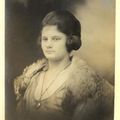
Mrs. Walter (Jennie) Kostanski Sr., (1904-1998), of Millers Falls, MA
interviewed by Henry Hmieleski (1930-1999)
on June 24, 1994. Tape 15 of 16
Edited by Pam Hodgkins 08/15/2025 & Jeanne Sojka 03/18/2026
Henry: June 24th, 1994. I’m visiting Mrs. Jennie Kostanski, and I’m going to interview her. This is one of the series of interviews being conducted with Eastern European descendants.
And Mrs. Kostanski’s parents, I believe, are from Poland, are they not?
Jennie: Yes.
Henry: Do you know what year they came, Jennie?
Jennie: Oh, I wouldn’t know that. Probably the early 1900s, I’d call it.
Henry: The late 1800s, yeah. 1800s, I’d call it.
Jennie: 1800 and, about 1895, they were, I’d call it about 1895 myself. I didn’t.
Henry: Did they come to the town of Erving?
Jennie: Right.
Henry: Now, was there somebody there, Mrs. Kostanski, that they came to?
Jennie: My father came first, and there was a home down where Waidlich’s Farm is.
I don’t know what they would call that down there. Waidlich’s Farm is on the hill, and this was a home there, down the hill, right on the river.
Henry: On the Erving side?
Jennie: Side. There’s a bridge there, and there’s a home right in there. I believe that home is still there. The boat, I think it’s a boat place down there now.
Henry: Did they, you don’t know where they came from?
Jennie: No, I don’t know.
Henry: All you know is that they came from Poland, but you don’t know the town?
Jennie: No.
Henry: Did they come together, or did they meet here?
Jennie: No, my father came first.
Henry: Oh, he came first, that’s right.
Jennie: And he was single. Then he sent a passport to my mother to come here. Then they got married in the Town of Erving. And they lived there a while, and they lived on the Erving side on Gunn Street for years. I was born there, had polio there, and my father worked at Millers Falls Tool.
After they got married, he worked at Millers Falls Tool. And always belonged to the St. John’s Church. That’s where I was baptized.
And that’s where they got married, St. John’s Church at Millers Falls. And what else did you want to know?
Henry: Well, did your parents move to the other side, or was that after you got married?
Jennie: After they got married, my father worked in a tool shop, and they lived on the Erving side over there. I couldn’t tell you how long.
And they bought a farm, and we had a farm in the town of Montague. And I went to school on the Highland School in Millers Falls. Went as far as the seventh grade and got out of there and worked all my life.
And my mother worked at the rag room. My father worked at the IP [International Paper] in Turners Falls for years after they moved to Turners. But that was later.
We had the farm. Probably talking out of turn here.
Henry: No, no, no. That’s fine.
Jennie: As I said, they had the farm. Then when they sold the farm, which the town’s water power [Northfield Mountain hydroelectricity facility?] has got all that land up there now, then they moved to Turners Falls.
And he worked at the IP [International Paper]. My mother worked at the rag room in Millers Falls. And I worked in the [Russell] Cutlery for years.
But I got ahead of myself, I guess, so I told them I went to Highland School there. As I said, I couldn’t. It’s kind of hard to remember all this stuff.
But after getting out of Highland School, they bought that farm. Stayed on that farm for a good many years. And then they moved to Turners.
And he worked at the IP, my father. My mother worked at the rag room in Millers Falls. And I worked at the Cutlery.
Henry: By the rag room, you mean in the paper mill?
Jennie: Millers Falls Paper Company. But he worked at the IP. I worked at the cutlery.
From there on in at the cutlery, well, I worked probably three, four years. And met my husband and got married.
Henry: When they moved to Turners, did you leave St. John’s and come over to a church in Turners then?
Jennie: Right, right. We lived in Turners. And I got married in Turners Falls at Our Lady of Czestochowa Church, the old church.
Henry: On, I forget the name of the street now. Upper L Street, way up on L Street.
Jennie: Right next to the Knights of Columbus up there. Right across where St. Mary’s is. Yeah, right across from where St. Mary’s is.
Henry: That’s where it was then. That’s where you got married.
Jennie: That’s where we got married, right.
Henry: What year was that you moved? 1921.
Jennie: 1921. I was married 68 years. And we stayed, we lived there for a while. After we got married, we lived with my mother.
And we, my husband went out to the mines. So I worked out there and he worked on the section, on the turntable in East Deerfield for years. But then he went to the mines and came back.
And I still worked at the Cutlery. And after he got back from the mines, he was out there a month, made no money. So he came back.
And when he came back, we moved to Millers. And that’s where we lived all the rest of our lives in Millers Falls. I had my children in Millers Falls.
Henry: Walter and Henry.
Jennie: Walter and Henry, right. And I had Walter in Millers Falls. I’m wrong because I had Henry in Turners Falls. And, you know, I should have some of this stuff down myself, but you get all this.
Henry: It’s a long time ago.
Jennie: This is a long, long time to remember this stuff. After all, we were married, as I said, 68 years. And it’s pretty hard to remember everything.
But we did hit a Depression, too. My husband came back from the mines. Couldn’t get a job.
No work. Depression was on. Finally got a job in the paper mill.
And Walter was born in Millers Falls. Then we moved back to Turners after that. And he still worked at Millers Falls.
And I didn’t work after Walter was born. But we went back to Turners again and lived with my mother because hard times.
Henry: I think Walter told me that your father, his father, your husband, for a time he only got one day a week in the paper mill.
Jennie: One day a week, right. So they were only working one or two days a week, and there was nothing to live on, but they gave you food stamps. And we never lived on welfare.
We passed the buck, and I got a job in the Millers Falls Tool, and worked there for 22 years. My mother took care of my children, and I was living with my, we were living downstairs in my mother’s home at that time. And Henry was born there.
And after that, things went a little better. We worked three, four more days, so we moved to Millers again. And when we moved to Millers, well, then it was tough going.
We went renting, renting homes. Never had a home at that time, couldn’t afford it. And lived on the food stamps as far as you could.
And cooked soup bones, and my husband was a great hunter and a fisherman.
Henry: Fisherman.
Jennie: Fried fish, kill rabbits, and eat squirrels.
And that was, and the children always enjoyed that, and potato pancakes. And so after a while, we got to where we could buy our home. We moved back, as I said, then.
Well, after Walter, we went renting and renting, and finally we moved back to Turners. But the kids had been going to school at the time and all. So after we moved back to Turners, we bought a home over there, and not to Turners, I’m sorry, there, no, I made a mistake.
We lived in Millers, right along.
Henry: What street was that, Jennie?
Jennie: We lived on South Prospect Street.
Henry: South Prospect. That’s up by St. John’s, isn’t it?
Jennie: It’s, you know where the Polish Hall is? St. Stan’s? Yes. Right across the tracks right there. But we had a we rented there, and then we went to rent from there.
The woman wanted $5,000 for the home, which we could not afford. So it was so hard at that time that you had to. A man collected 50 cents for a pair of pants that I could buy for my kids. That’s how bad Depression was.
And then we went to another place to live for $15. Our rent was $15, so we lived up there 13 years. And after that, I got a job in the tool shop and worked 22 years there.
Walter worked 30, 33 years in the paper mill. Then we owned a home in Millers Falls there for 50 years. And there wasn’t too much more that I could tell you on any more than that.
Henry: Jennie, did your parents join the societies, any of the societies? Do you remember?
Jennie: My father used to belong to the St. Stan’s. They used to have a St. Kazimierz Society in Millers Falls at that time. And my mother, she belonged to the ah don’t know what you’d call it the Ku Klopotek in Turners Falls. Your mother belonged there too?
Henry: I think so.
Jennie: Yeah. And that was the only place that they ever belonged.
They couldn’t afford it. We worked hard with the farm. And I couldn’t go to school.
I got only as far as seventh grade because there was no money, which I would have liked to have gone. And had to work on the farm, sell vegetables to live, to survive even on that farm.
Henry: When Walter was only getting one day a week in the paper mill, did he work somewhere on a farm? Not your farm, but did he work for another farmer?
Jennie: Yeah, for Mr. Dymierski.
He used to go up there, pick cucumbers, and they used to raise some tobacco. And he worked up there for a bushel of potatoes.
Henry: But you used the food stamps. My family did too back in those days.
Jennie: Well, you used food stamps. There wasn’t much.
Yeah. As I said, whenever he’d go out and hunt and bought a soup bone for a quarter, you’d have to make soup for a week and cook your own macaroni in order to survive. We didn’t ah it was not peaches and cream of a life.
No. And then they had Prohibition too. That hit pretty hard.
But when he worked down to the East Deerfield, that was when we first got married. He had to work seven days a week for practically $25. Seven days a week.
Henry: And where were the mines? Did he go out of state too?
Jennie: Oh, yeah. Pennsylvania.
Henry: Pennsylvania.
Jennie: The gang decided that they wanted to fire him, his father. And his relatives thought that there were wonders out in the mines. So Walter ah we had a car at all times because when we got married, Walter’s father had given him the car.
And so they got out in the mines. And when he was out there ah but I didn’t go. I had a job in the cutlery, and I stayed on my job.
But he only stayed out there a month, and he came back. There was no money out there either.
Henry: Remember going to any picnics, Polish society picnics?
Jennie: No, we never went to the picnics.
Henry: No?
Jennie: No. They did have picnics up there. They’ve got homes up there now.
But we didn’t ah was a kid, about 14. Well, I’d get up there up to the picnics at that time, but that didn’t mean, No. No, in [garbled], it was just a kid picnic.
Henry: You used to swim at Green Pond?
Jennie: No, we didn’t never swam. And Walter, No. He didn’t. We used to go out every summer to Old Orchard.
Every year, we’d take the kids. After things got better, we’d both work, and things got better. We’d take the children to Old Orchard [Maine] every summer.
But as far as going swimming, you never had the time to go.
Henry: Well, Walter and Henry did all right for themselves, didn’t they?
Jennie: Well, I’ll tell you, I’m very happy with my children. They are Walter. After he got out, then Walter had gone to high school, and Henry, we sledged all the way through to put them kids through. As I did say once, that I had to pay out for what you’d buy for the children’s clothes. You’d have to pay fashion shop in Greenfield a dollar a week.
And you wouldn’t see a pay and see one day’s pay, it was pretty tough living. And as I said, work for the bushel of potatoes. Tough going.
Henry: They were tough days. Did you know my mother, Anna [Hmieleski]?
Jennie: I was in the organization with her. I loved her. I loved her like my own mother. She was the best. She was so outstanding.
I think there wasn’t a person in Turners that didn’t love her. She slow and easy, but she was accommodating, and she was a lovable person. And I think at one time, just before I had left Turners Falls, I met her at one time, and I said, “How are you?” And always looked outstanding with dressing up.
Nice. I knew either dad very good. They’d sing in Polish, the old Polish songs.
And oh, yes, I knew the family all the way through. And then Helen [Hmieleski], of course, we lived on 3rd Street, and they lived on L, so Helen used to come over to the house every now and then.
Henry: Yeah, right on the corner, yeah.
Jennie: And so that was about the story, I guess. There’s two boys that I love, and now I’ve got eight grandchildren.
Henry: Eight grandchildren.
Jennie: And seven great-grandchildren.
Henry: And seven great-grandchildren. Good. And you’re 90 now, Jennie?
Jennie: 90. I was 90 last Tuesday.
Henry: Congratulations.
Jennie: Thank you. And Walter was 89 when he died. As I said, we were married 68 years.
We had a good life. It was tough going, but we had a good life. And we had a, when we moved to Millers Falls, to West Main, well, that’s where we bought the house.
We’ve had it we had that for 50 years, that home. And he didn’t, he was working more so then, because it’s a paper mill. And the paper mill got better and better and better.
Henry: You don’t remember then your parents ever talking about the old country very much?
Jennie: No, we never spoke of the old country, no. The old country, no. We in fact, when they had Polish school in the evenings, I used to go to Polish school.
And but we never had the interest of talking. My grandmother came here from Poland. My mother, my father and mother, after they bought the farm, they got my grandmother over here.
They had to have passports. And my mother got her brother over here. And then my father’s father came here.
This was all on passports. And they would chip in a certain amount. I couldn’t tell you how much.
And then they’d come into New York, and they’d pick them up. And they stayed with them until they passed away.
Henry: Well, they stayed.
Jennie: Yeah, right. My grandmother stayed on the farm with us. And then my mother got my, her brother to this country.
And he got married. His wife got blind. They still were living on the farm.
So the farm business was just, you know, our family farm. But then the water power really bought that all out of it. I guess it’s really nobody can go in through there.
I guess it’s condemned, isn’t it?
Henry: Well, it’s kind of restricted since they bought everything out, I understand. I don’t know an awful lot about it.
Jennie: You know where it’s under the bridge there on Federal Street? Well, it’s on the left-hand side.
It was all in there. All that land, that was our land in there.
Henry: So that was handy to go fishing.
Jennie: That’s right. We had a brook there. Yeah.
And then we had of course, we had cattle, had horse and cattle. Killed the, my father killed the old calf off. And we’d eat, that’s what we’d have for food.
At that time, it was tough for them going when they started. But then, as I said, even if they weren’t making too much money, but somehow or other, they bought homes. And even if they did have soup bones from time to time, it wasn’t pork roast.
It wasn’t, it wasn’t our roast of beef or anything, but we had good steaks from the old cattle.
Henry: Yeah. Yeah.
Jennie: Chicken. They had chickens all the time of all kinds. And the roosters were pretty, pretty nice.
They were well fed. But they really worked hard. And like I said, my kids were brought up not in the best of life, but they are happy now, I guess.
Henry: I think they learned some good values from you and Walter.
Jennie: I think, I think they, if Henry was here, he could tell you a little more, because he was more around with me, you know. But still, there was a punishment, you know.
If you didn’t go to school, that meant you’d get. And one time, he said to Henry. His father said to him, “Henry, do you go out and smoke?” “Oh, no, Pa,” he said, “I don’t smoke.”
Well, he said, “okay.”
So this one day, Walter goes down the street. There’s Henry down there, down at the Spanish Garden, pumping the old pipe. Well, that was the end of Henry smoking.
But Walter, he was never, Walter was more, he was an altar boy. And they’re two boys, but they’re both different. But they’re awful good to me.
Henry: Well, they certainly did turn out right. That’s for sure, Jennie.
Jennie: Well, like I said, they always got what they wanted at home.
And if we had a dollar and they needed it, we never said no to them and never said no to anything they wanted. And as I said, it wasn’t a home that we’d fight or things like that. And brought up with hard living.
Henry: When your husband was. Your husband served in the Polish Army.
Jennie: Oh, yeah. Oh, yeah.
Henry: Where did you stay then, Jennie?
Well, he was in the Polish Army. When he came out of the Polish Army, I met him.
Henry: Oh, okay.
Jennie: I met him in 1921. Oh, that’s right.
Henry: Okay.
Jennie: He joined the Polish Army in Niagara Lake or something up in there. And I didn’t meet him until he got back from the service. And I only went six months with him, and we got married in 1921.
Henry: Did he go overseas?
Jennie: Oh, yeah. He was out in France. He was. Oh, yeah. He fought the Germans, he tells me. Yeah, he was, I don’t know how long, I think he must have been in there two or three years, I guess Walter was.
Henry: I think they call that Haller’s Army.
Jennie: Yeah, yeah, yeah, Haller’s Army, yeah. He served there, I guess.
Henry: And your boys both served in World War II.
Jennie: Yeah. Navy. Then Walter in the Navy was in the armed guard, and Henry was whatever he was on there some ship he was on there, I forgot now what ship he was on.
Henry: I think it was a cruiser, Jennie, I’m not sure, but I saw a picture of it once. I think they got hit.
Jennie: Walter got hit.
Henry: Walter got hit?
Jennie: He was a gunner’s mate.
Henry: Yeah?
Jennie: Yeah. He got hit because he lost, he got his guitar and stuff and everything. He really got hit very hard, I guess. Yeah.
Well, Henry was on USS St. Paul. That was the ship that Henry was on. And when he came back, well, that meant he wanted to go to school for undertaking.
Well, that meant to try to help them out too. And then he wanted to get married, and he wanted a diamond ring for the girl and all. And we helped them along as far as we could.
But I guess they turned out to be all right.
Henry: I guess they did.
Jennie: Of course, and Walt, Sam Blassberg was right after him to have him get into the State House.
That’s who helped Judge Blassberg. And he said, “Walter, I’m sure you’re going to make it”. He got in there.
He was in there a long 14 years.
Henry: And he was a good legislator too.
Jennie: He was. He really was. Like I said, he’s my child, but he is as honest as you can make it. And if he’s going to do something, he’ll do it for you if he can.
And so that was really all my life, I guess, is what I could tell you. I can’t remember much of anything else.
Henry: Well, we appreciate very much your taking this time to tell us these things. These people are trying to learn as much about people like yourself as they can. And I think it’s a very worthwhile project myself. I appreciate the chance to come and talk to all of you.
Jennie: Well, like I say, it probably isn’t the very thing that I would like to tell you, but that’s about everything that was right along in my life.
Henry: Jennie, I hope I remember as much as you do. When I’m 90, I like to have your memory when I’m 90.
Jennie: You speak like everybody that comes in here. The kids, I tell them, that’s street. They say, no, that’s wrong.
They say, how can you remember way back? But like I say, if I wouldn’t be crippled, like Henry said, I wouldn’t have to be in the nursing home, but my feet are gone too. And as I had polio, that doesn’t help at all. I was three years old when I had polio.
And I got a picture. They brought a picture of me up there when I was five years old. My mother had that picture.
Henry: That’s nice. Thanks very much, Jennie.
Jennie: Every word that I’ve said is very true. Haven’t told you a lie.
Henry: I know that.
Jennie: I’m sorry that I didn’t probably think, but if I could find out, but I couldn’t ever find out where they came from.
Henry: That’s all right. That’s fine.
Jennie: You know, they had so many things in Poland that you don’t know what direction they came from, you know.
Henry: It was always divided up.
Jennie: It was all divided up, right. And so that’s about the story.
Henry: Okay, thanks a lot.