
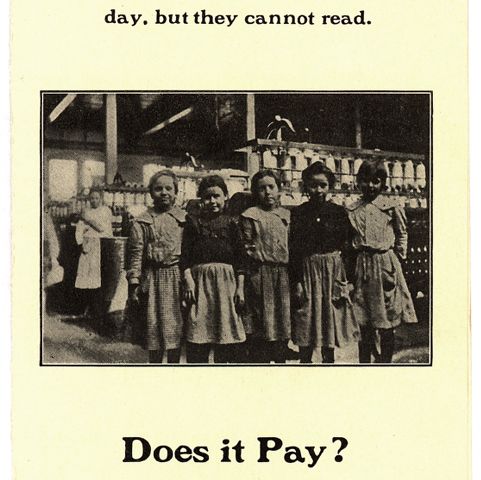
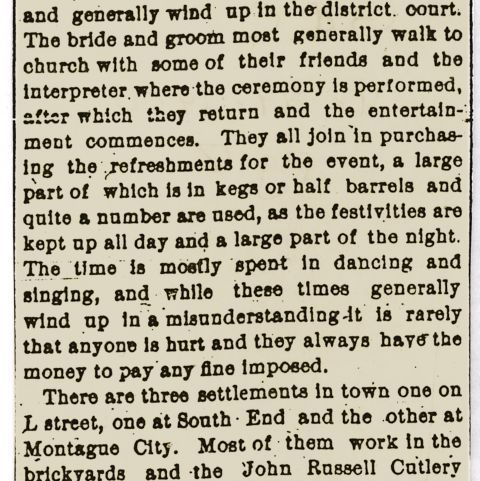
John Russell started his cutlery manufacturing business in the Cheapside section of Deerfield, Massachusetts, in 1834, at the “Green River Works” along the Green River. The adjacent town of Greenfield annexed Cheapside from Deerfield in 1896. Russell moved his business in 1870, to the newly-planned industrial city, Turners Falls, Massachusetts, on the Connecticut River. In 1880, the cutlery employed 51% of the people who worked in factories at Turners Falls. In this photograph taken around 1890, there are both men and boys who worked in the Grinding Room. Russell employed a mix of native- and foreign-born workers to make over 150 kinds of pocket knives among other types of cutlery. For example, drawn by the promise of work, almost 300 Bohemian immigrants left their farms in central Europe (today the Czech Republic) to start life anew in the industrial village of Turners Falls. Tragically, many would die young from “grinder’s consumption,” lung disease from inhaling metal and stone particles in the grinding room. By 1899, 28 states, including Massachusetts, had set a minimum age limit of 12 for manufacturing work, and a concerted reform campaign to ban all child labor under the age of 16. Around 1900, labor reforms would reduce the number of hours children could work to 58 per week.
Russell Cutlery, photographer. John Russell Cutlery Grinding Room Employees. Photograph. ca. 1890. Pocumtuck Valley Memorial Association, American Centuries. https://americancenturies.org/collection/l06-033/. Accessed on October 17, 2026.
Please note: Citations are generated automatically from bibliographic data.